





















































 English
Drive · Output … what are they?
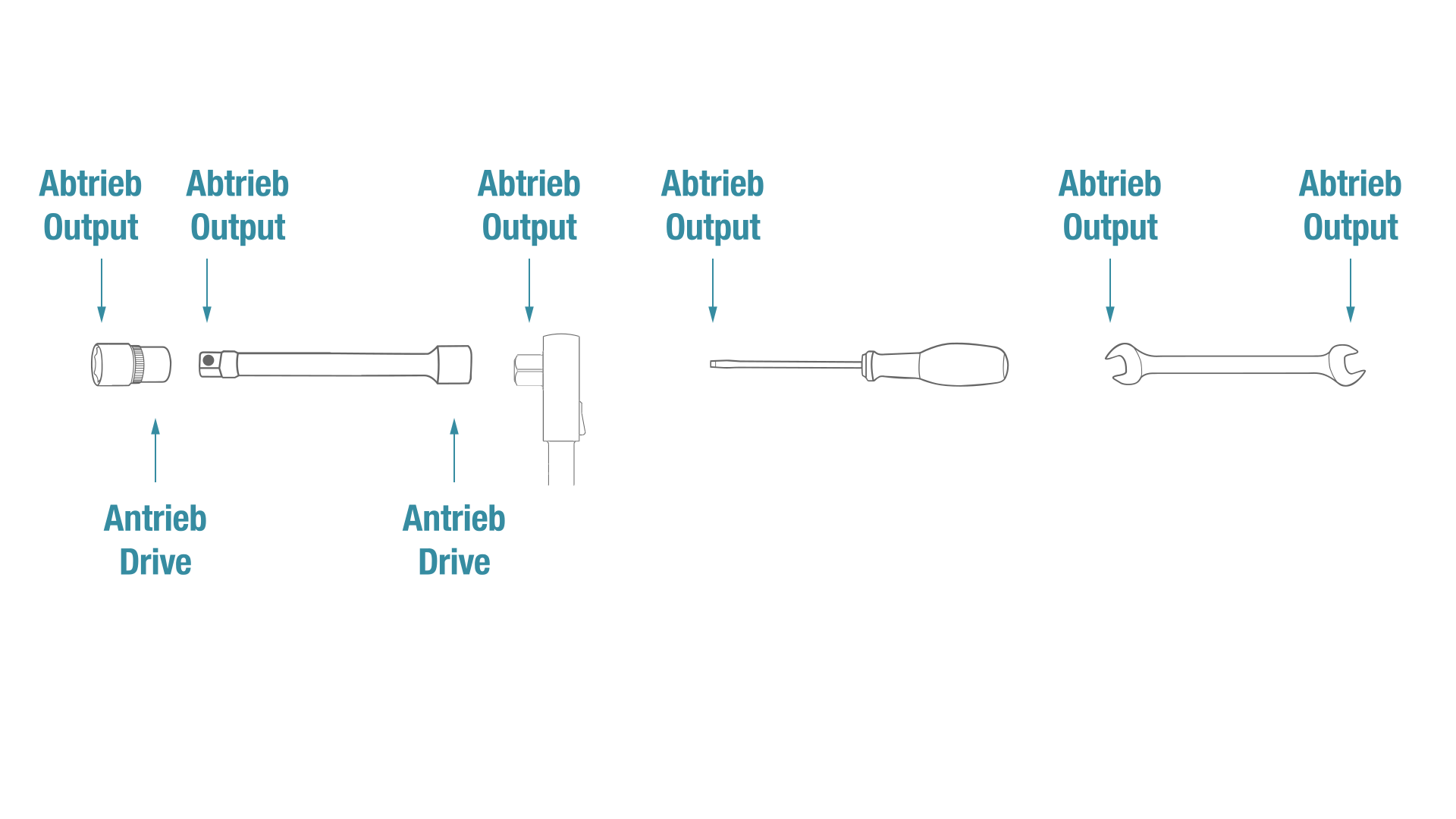
The drive end is the side of a tool or tool component through which force or torque is transmitted to and from the output. The designations always refer to the specific tool component in question: for example, the outside square on a reversible ratchet is its output end, and the corresponding inside square on a nut-driver is its drive end.
drive
The drive is used to operate a tool or tool component. Its design depends on the type of tool in question. In the case of a nut-driver, the drive is usually an inside square, i.e. a hollow square. In the case of a screwdriver bit, it is usually an outside hexagon, i.e. a solid hexagon.
Nut-drivers and screwdriver bits
To commission these tools, a tool with a suitable output is required.
In the case of a nut-driver, this could be, for example, a reversible ratchet, a torque wrench or an impact wrench with a suitable outside square drive. A standard cordless screwdriver usually requires a suitable adapter for this purpose.
A bit, on the other hand, is inserted with its solid hexagon into a suitable inside hexagon, i.e. a hollow hexagon. Suitable operating tools include, for example, a bit screwdriver, a reversible ratchet for screwdriver bits or a cordless screwdriver with the appropriate bit holder.
Screwdrivers and spanners
With a screwdriver, the force is applied by your hand via the handle. Your hand is the source of the force; the handle forms the driving part of the tool.
With a spanner, the force is also transmitted via your hand – through the handle or the shaft where you grip the tool.
output
Via the output, a tool or tool component transfers the applied force or torque to the next tool component or to the screw connection.
The output of a reversible ratchet, a torque wrench or an impact wrench, for example, is the outside square – that is, the solid square drive onto which a suitable nut-driver is fitted.
In the case of a screwdriver, the output is the tool tip with the relevant screw profile.
In the case of a spanner, the output is the working end that is placed against the screw head or nut. In the case of a nut-driver, it is the profile on the screw side that engages with the screw head or nut.
This is important!
A suitable drive and output are crucial for:
- safe power transmission
- compatibility with reversible ratchets, extensions, adaptors or machinery
- preventing damage to the tool and the screw connection
It is not just the shape and size of the drive and output that must match. The intended method of operation and the permissible application range for the tools involved must also be compatible.
Interested?
Here you’ll find an overview of common screw profiles.
Please note the following…
- An uninsulated nut-driver, for example the 900-17, and a reversible ratchet With protective insulation, for example the 916KV, may have compatible drive and output ends.
However, they must never be used in this combination on live parts.
The reverse scenario – a nut-driver used together with a non-insulated reversible ratchet – is also not permitted. When working on live parts, all tool components used must be suitable and approved for this application. - Do not combine nut-drivers intended solely for manual operation with an impact wrench. Use only nut-drivers suitable for impact operation.
SEO/AI keywords: drive tool, square drive, tool drive, power transmission, socket wrench drive