






















































 English
We’ve got the hang of it – at just the right moment!
- Accuracy at all times. Whether manual or electronic, and even in isolated applications – we can meet every requirement
- Wide measuring range across the entire range: from 0.02 to 2000 Nm
- Forged precision – developed and manufactured by HAZET, ‘Made in Germany’
- No more back-turning
- Complies with the current DIN EN ISO 6789-2:2017 standard
- All wrenches come with their own calibration certificate and serial number
- Dedicated service centre offering the best after-sales service in Germany, directly accessible
- Unique maintenance service packages
- In-house DAkkS-accredited calibration laboratory (for torque and rotation angle) in Germany, directly accessible
Product highlights
Always up to date - We are constantly developing our product portfolio. So that we can provide you with the best possible support for your work and your projects. And to make your decision even easier, we regularly have attractive promotions for you. Do you already know these current highlights from our range?
Which HAZET torque wrench is right for your application?
Whether for precision screwdriving, workshop use or industrial applications – HAZET offers Torque wrenches for almost every application range. The following overview will help you choose the suitable tool group or series.
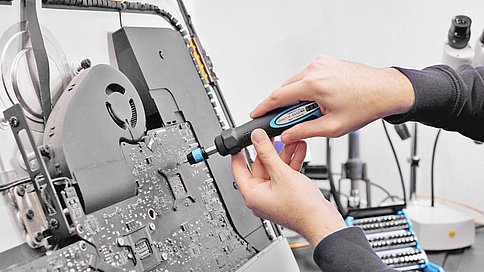
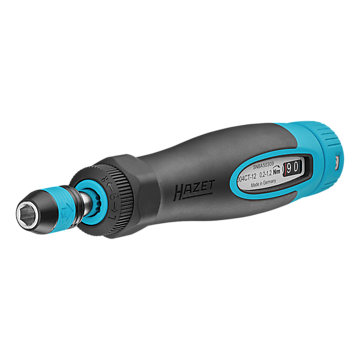
Precision screw connections in the lowest torque range
For precision screw connections on small components, in the cycling sector, in electronics, in control cabinet construction or for sensitive components
Suitable range: Torque screwdrivers
Typical range: 0.02 – 10 Nm
Advantage: High precision in the low torque range, compact design and 1⁄4″ screwdriver bit location notch
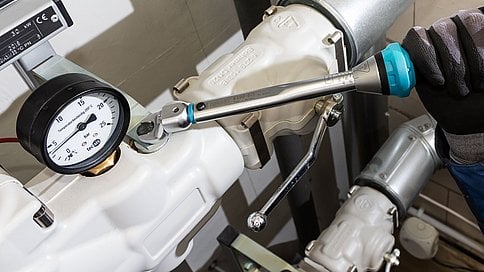
Workshop, tyre service, passenger cars and commercial vehicles
For controlled screw tightening in day-to-day workshop use – for example, on wheels, the chassis (frame), the engine or general screw connections
Suitable series: SYSTEM 5000-3CT
Typical range: 1 – 800 Nm
Advantage: Robust workshop design with reversible ratchet for professional, continuous operation.
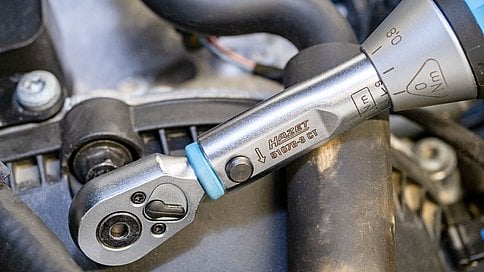
Low torques with a reversible ratchet for screwdriver bits
For screw connections in the lower torque range, when working with screwdriver bits and a compact ratchet function is required
Suitable series: SYSTEM 5000B-3CT
Typical range: 1 – 25 Nm
Advantage: Combination of torque wrench and reversible ratchet for screwdriver bits.
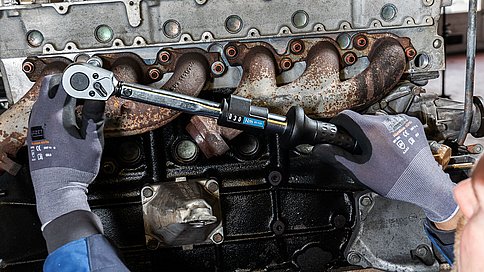
Quick and easy adjustment
For workshop applications where the set torque value needs to be particularly quick and easy to read
Suitable series: SYSTEM 5000CLT
Typical range: 20 – 320 Nm
Advantage: Large display in the viewing window for convenient torque setting
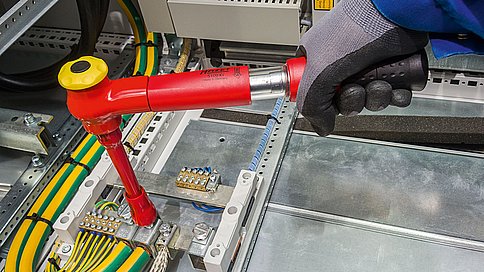
High-voltage and electrical applications
For controlled screw tightening on electrical systems and high-voltage vehicles
Suitable series: SYSTEM 5000KV
Typical range: 2 – 120 Nm
Advantage: With protective insulation for work up to 1,000 V in accordance with EN IEC 60900:2018
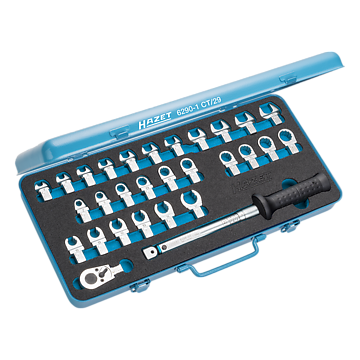
Applications using insert tools
For screw connections where open-ended, ring-spanner, open-ring or other socket-type insert tools are used
Suitable series: SYSTEM 5200-3CT and SYSTEM 6200-1CT
Typical range: 2 – 500 Nm
Advantage: Versatile use thanks to the 9 × 12 mm or 14 × 18 mm insert square.
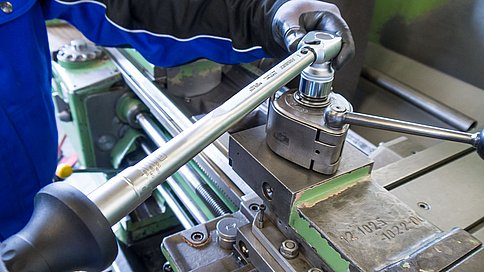
Industrial applications
For demanding applications in industry, the automotive sector, aviation, wind energy, offshore and machine construction
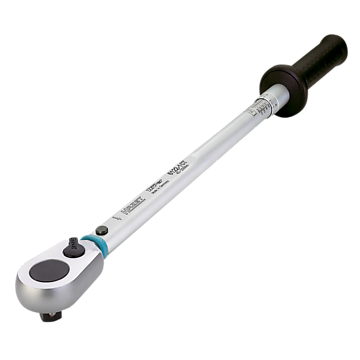
Suitable series: SYSTEM 6000-1CT
Typical range: 1 – 2,000 Nm
Advantages: Wide torque range, high accuracy and professional calibration and service concepts.
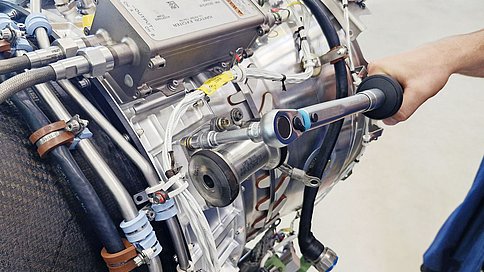
Applications using US units of measurement
For industrial and workshop applications where torque values are specified in lbf.ft (pound-force foot) – for example, in the North American market or for machinery and equipment manufactured to US specifications
Suitable series: SYSTEM 6000-1CT US
Typical range: 5 – 600 lbf.ft
Advantage: Scale graduation in lbf.ft for direct use without the need to convert torque values.
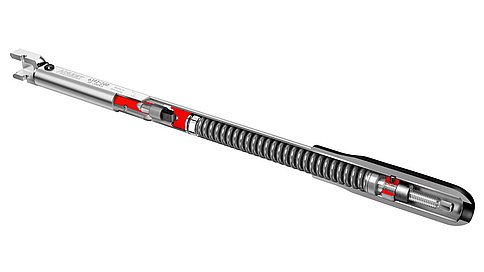
Mass production with a fixed torque setting
For recurring screw connections with a permanently defined torque value
Suitable series: SYSTEM 6300CT
Typical range: 2 – 320 Nm
Advantage: Fixed torque value to prevent accidental adjustment.
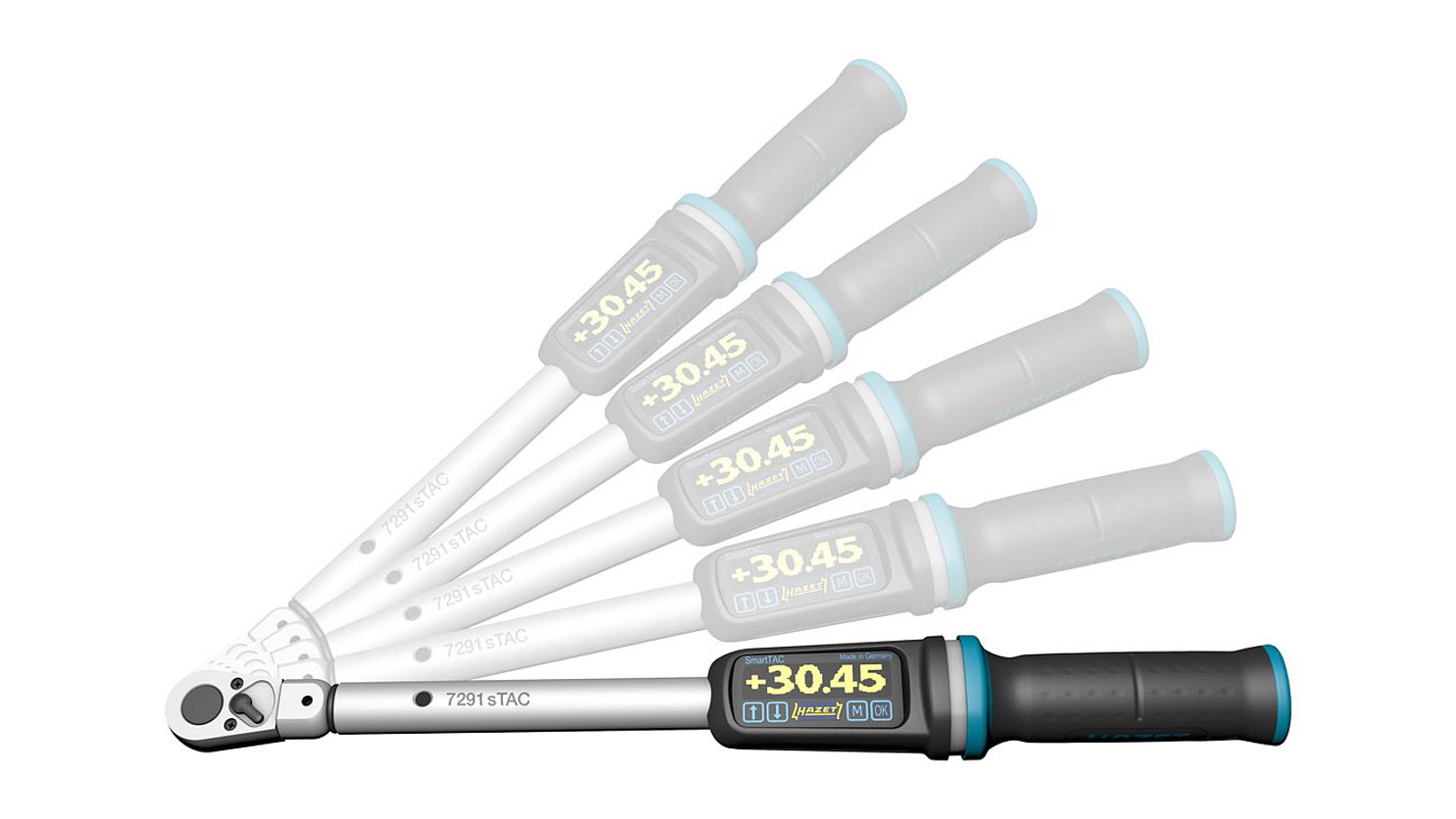
Electronic measurement and documentation tasks
For quality-critical screw connections with electronic torque and angle measurement
Suitable series: SYSTEM 7000sTAC
Advantage: Electronic measurement of torque and rotation angle, as well as support for screwdriving processes requiring documentation.
What exactly does ‘torque’ mean?
Torque is a physical quantity and is also designated as rotational force. The unit of torque is the newton-metre (abbreviated to Nm). One newton-metre represents the rotational force required to rotate an object with a lever arm about a specific point.
Torque wrenches have been designed to apply a precise torque to a bolt or nut. The use of a torque wrench ensures that bolted joints are tightened with the correct force to guarantee a secure and reliable fastening.
What do I need a torque spanner for?
Torque technology and torque spanners help to avoid overtightening screws and the associated material damage. By evenly distributing the tightening torque, torque spanners ensure consistent connections, regardless of the size of the torque. In addition, the controlled tightening of bolts allows torque values to be maintained, which is particularly important in quality standards. Torque spanners are therefore indispensable tools - for professionals, but also for amateur screwdrivers.
What is torque technology?
Torque technology refers to the application of torques, in particular the measurement, control and application of torques in various technical applications. Torque is a physical quantity that indicates the rotational effect or torque acting on a body. Torque spanners play an important role in this context.
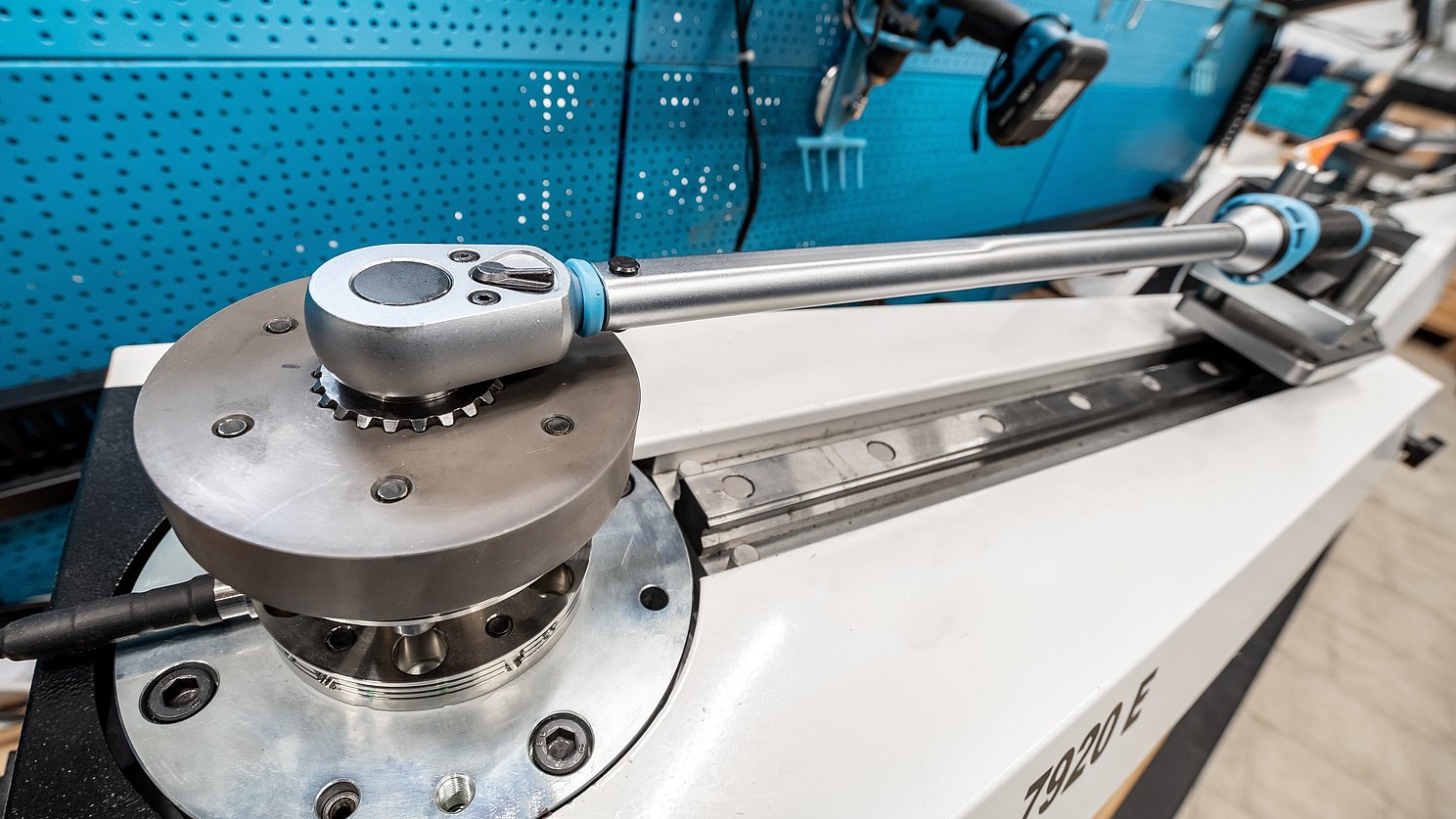
Why is it important to ensure that the torque is compliant and calibrated?
The conformity and calibration of torque wrenches play a crucial role in their accuracy and safety. Our HAZET calibration laboratory carries out measurements of torque and rotation angle. Through our accreditation by the German Accreditation Body (DAkkS), we guarantee the highest level of technical calibration expertise.
We are authorised to issue calibration certificates for parameters such as torque and rotation angle. These certificates guarantee that the tests we carry out comply with internationally recognised standards.
Here you will find the standards for these measured quantities:
- DIN EN ISO/IEC 17025
- Torque (DIN EN ISO 6789-2:2017)
- Rotation angle (VDI/VDE 2648 Part 2; excluding clause 4.2)
When should torque spanners be calibrated?
Torque spanners should be calibrated regularly to ensure the accuracy of the measurement, guarantee maximum safety and meet the strict quality requirements in industries such as aviation, the automotive industry or renewable energies. Particular attention should be paid to carefully documenting all calibrations. The documentation should contain information about the calibration performed, the results and compliance with the standards. This provides a traceable history of the calibration and is of crucial importance.
Where are torque spanners used?
Torque spanners are used in various industries, especially where precise torques are crucial when assembling connections.
Automotive industry
Torque spanners are used in automotive production and maintenance to ensure that bolts and nuts are tightened to the prescribed torques. This ensures that relevant parts such as brakes, wheel suspensions and engine components are securely fitted.
Aviation industry
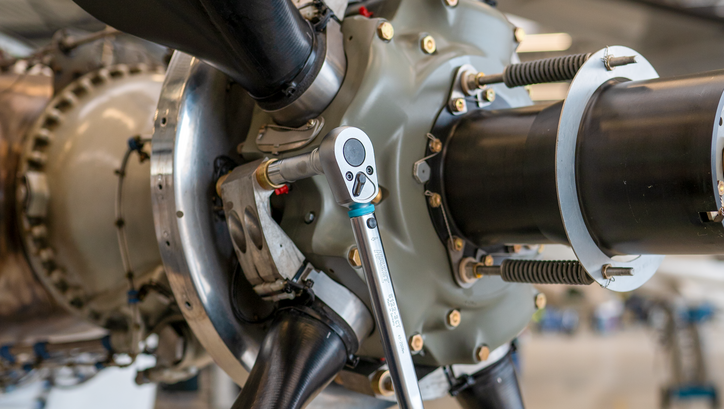
Precision is of the utmost importance in aviation. Torque spanners are used to assemble aircraft components, engines and fasteners with the exact torques required. This is crucial for the safety and performance of aeroplanes.
Does the lever length of the torque spanner and angle make a difference?
Yes, the lever length has a considerable influence on the torque. The lever length influences the torque in so-called direct proportionality. This means that a change in lever length leads to corresponding changes in torque. If the lever length increases, less force must be applied to achieve the same torque, and vice versa.
Torque tools
Our recommendation for the test/calibration interval is based on the DIN EN ISO 6789:2017 standard for torque wrenches, which recommends recalibration after one year, after 5000 loads or after every overload. The inspection intervals must be shortened in case of increased quality and safety requirements or intensive use. The calibration interval is specified by the user, as he is responsible and knows the use of the test specimen.
A torque wrench is a measuring instrument that should not be used for purposes other than its intended use. Other tools, e.g. the HAZET 6396 or 6397 tool holders, or a compressed air impact wrench or cordless impact wrench, are better suited for loosening fastenings.
HAZET tests, calibrates and certifies torques, including those from other brands. However, repairs are not available. We would be happy to provide you with an attractive offer to purchase a technically comparable HAZET torque wrench.
Our torque service centre
We not only attach great importance to the quality of our products, but also to our services. We are your direct contact for all questions relating to maintenance, adjustment, calibration and complaints handling for our torque tools.